Market Morning or Museum Hour: Choosing a First Stop
Choose a market morning or museum hour as your first stop to set a curious, comfortable pace and give the rest of your day a clearer focus.
The common mistake in choosing a first stop is picking the place that sounds most important, then arriving tired, rushed, or unsure what to look for. A market morning or museum hour can each make a better beginning, but they offer different kinds of orientation: one puts you among the routines of the day, while the other gives you a frame for understanding what you see afterward.
Market morning or museum hour sets a different pace
Start with the kind of attention you have available. A market asks you to notice movement, sounds, exchanges, and what people come to buy. A museum gives you time to pause, read, compare objects, and let someone else’s arrangement guide your first impressions.
Neither choice is automatically more authentic or more informative. A market can feel lively but confusing if you are still finding your bearings. A museum can offer useful context but leave you wanting to step outside and see how the city is being lived in right now.
Think about the rest of the day, too. If you have a walking route through neighborhoods, a market can give you a natural starting point and a reason to linger. If you plan to visit a historic district or a particular landmark, a museum may help you recognize details that would otherwise pass unnoticed.
Check the practical conditions before choosing
Before deciding, look at opening hours, market days, admission arrangements, and how long it takes to reach each place. A market may be most active early and quiet down later; a museum may open later or have timed entry. Check current information from the venue or local listings, then avoid building the morning around a place that will not be open when you arrive.
Consider your energy and comfort. After an overnight trip, a museum with benches and a clear route through its galleries may be easier than a crowded outdoor market. If you feel alert and enjoy navigating busy spaces, the market may be the more engaging choice. Weather matters as well: a covered market can work in rain, while an outdoor one may not.
Keep the first stop modest. You do not need to see every gallery or inspect every stall. Choosing a limited area or a single theme gives the visit room to breathe and leaves space for the rest of the day.
Choose a market when daily rhythms are your first question
Go to the market if you want to notice what a place is doing rather than begin with an explanation of what it has been. Watch how people move through the space, what is displayed near the entrance, and which stalls draw a queue. Notice the practical details: reusable bags, handwritten signs, shared tables, or vendors arranging produce for the day.
Be a considerate visitor. Keep pathways clear, ask before photographing people or their goods, and do not treat a stall as a display made for you. If you want to buy something, choose an item you can carry and use, and follow the seller’s cues about how transactions work. A brief greeting and patient attention often make a better opening than a stream of questions.
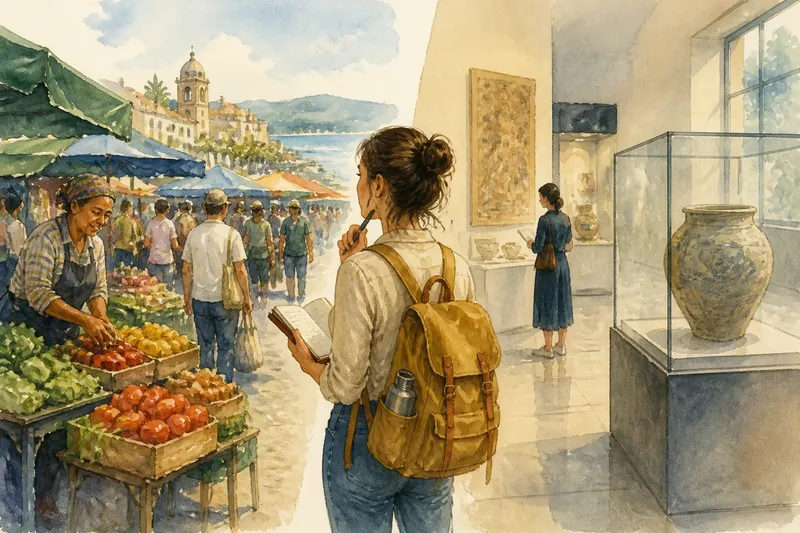
Say you arrive in a coastal city with a free morning and feel curious about what locals eat. You choose a public food market, walk one aisle without stopping, then return to a stall where a dish catches your eye and ask what it is. You might leave with a taste, a few new words, and a question about where those ingredients come from—something to carry into the neighborhood later.
Choose a museum when you want context before wandering
Choose a museum if you would like an organized introduction before exploring streets, buildings, or local collections. Rather than trying to cover the whole institution, look for a gallery that connects to something you expect to encounter outside: the city’s trade, local crafts, migration, landscape, or everyday household life.
Read the introductory panel, then spend time with a small cluster of objects. Ask yourself what materials recur, who made or used the objects, and what the display leaves unexplained. Labels can offer a starting point, but they are not the only way to look. Shapes, wear, repairs, and arrangements may prompt questions you can carry into the city.
It is not worth the effort to speed-read every label just to feel you have covered the museum. Pick a thread and follow it. If a gallery feels dense, step away for a moment rather than turning the visit into a test of endurance.
What should you ask before settling on a first stop?
Should I visit the market or museum first?
Choose the market if you want to observe daily activity and feel comfortable with a busy, less structured setting. Choose the museum if you would rather begin with interpretation, quiet, and a clearer route through a subject.
Can I visit both in one morning?
You can, if travel time and opening hours leave room to enjoy each without rushing. Give one place the role of your main visit and treat the other as a short stop, rather than trying to make both equally comprehensive.
What if the market is closed?
Look for a public food hall, neighborhood bakery, or small grocery where everyday choices are visible without requiring a special event. If those options do not fit, begin at the museum and save your market visit for another day.
How long should I stay at my first stop?
Stay until you have noticed a few details and formed a question that can guide what comes next. Leave while you still have enough energy to follow that curiosity elsewhere.
Let the first stop shape the next one
On the way out, write down one observation and one question. After a market, the question might be where a familiar ingredient is grown or how a local snack is served at home. After a museum, it might be whether a craft or material appears in nearby shops or buildings.
Use that question to choose your next move: a nearby street, a café, a public garden, or a conversation with a guide. The first stop does not need to explain the whole place. A market morning or museum hour works best when it gives you a specific reason to look again, with more care, as the day unfolds.