The Souvenir That Promises to Explain a Place
A souvenir can open a door to a place without standing in for its culture. Learn what to ask before buying, displaying, or telling its story.
The most common souvenir mistake is asking one object to explain an entire place. A carved figure, woven bag, or miniature landmark may carry a story, but treating it as a summary can flatten the people and histories behind it—and leave you repeating a claim you cannot support. A better souvenir is a prompt: something that reminds you to ask what it means, who made it, and what remains outside its frame.
Choose your approach by what you want the object to do
Before buying or describing a souvenir, decide what you are asking of it. You might want a keepsake, a conversation starter, a useful object, or a way to remember a question from your trip. Those are reasonable jobs. “Explain this culture” is too large a job for any single thing.
The distinction matters because souvenirs travel away from their original setting. At home, a textile may appear to speak for a whole region, even if it came from one workshop, one maker, or a design created for visitors. Keeping the object’s story in proportion does not make it less meaningful; it gives the meaning a more honest shape.
If you want a personal keepsake, let your own memory lead
For a keepsake, the strongest connection may be yours rather than universal. A small ceramic cup might remind you of the café where you paused during a long walk, or a paper map might bring back the route you took with a friend. You do not need to claim that the object represents local life. It can simply mark a moment you experienced there.
Keep a short note with it: where you encountered it, what you know about its maker or use, and what you still do not know. If the seller shared a specific account, record that as what the seller told you, not as a fact about everyone in the place. This small distinction helps memory stay vivid without turning a personal encounter into a sweeping cultural claim.
If you want an everyday object, ask about its use and maker
A useful souvenir can keep inviting attention long after the trip. A bowl, cloth, basket, or tool may be made for ordinary use rather than display. Ask whether it was made locally, what materials it uses, how people care for it, and whether its design has a particular name or purpose. These questions can reveal more than a broad label such as “traditional.”
Answers may be partial, and that is fine. A seller may know the workshop but not the history of a motif; a maker may describe a design as contemporary rather than inherited. Let the answer set the boundaries of what you say later. If the object’s origin is unclear, you can still value its color, texture, or usefulness without presenting uncertain provenance as settled.
If you want a conversation starter, leave room for more than one story
Some objects are sold with an inviting explanation: this pattern stands for welcome, this charm protects a household, this carved animal represents a whole community. Such accounts may be meaningful in a particular setting, but the same object can have different meanings across families, generations, or makers. Ask who uses that interpretation and where it applies.
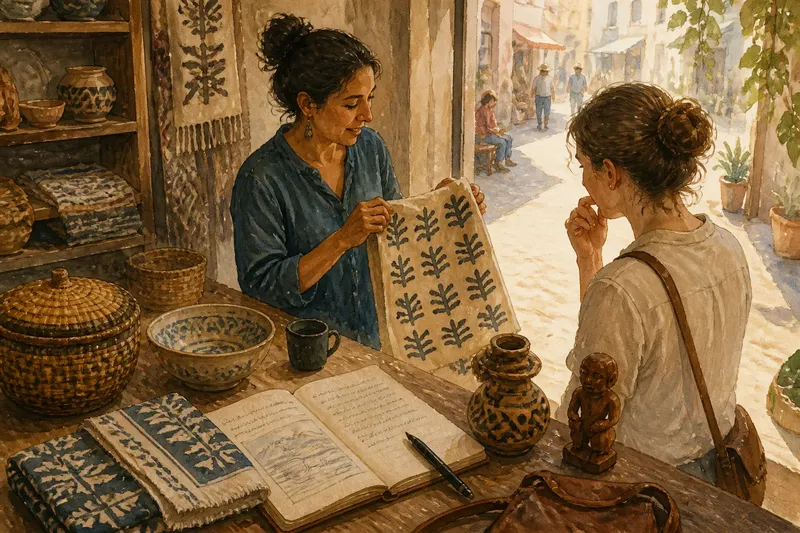
Imagine you are looking at a hand-printed cloth in a neighborhood shop. The shopkeeper says a repeated shape is associated with a local celebration. You could ask whether the motif is used only for that occasion, whether the design varies between makers, and whether visitors commonly misunderstand it. If the answers remain narrow, your later description can remain narrow too: the shopkeeper connected this version of the motif with that celebration. The object becomes a starting point for conversation, not a verdict on local culture.
If you want a history lesson, separate the object’s layers
An object can have several histories at once: the history of its materials, the techniques used to make it, its role in daily life, and the newer history of its sale to visitors. These layers do not always line up neatly. A craft may have older roots while a particular shape or color was adapted for contemporary customers.
Ask what is known about this specific piece, rather than jumping from its appearance to a grand account of the past. Who made it? Where was it made? Was it intended for household use, ceremony, trade, or display? Is the design old, newly developed, or a mix? If a detail cannot be answered, treat that gap as a limit, not an invitation to fill it with a romantic story.
If the story sounds too complete, ask what it leaves out
A tidy explanation can be appealing precisely because it makes a complex place feel easy to understand. Be cautious when a seller, label, or guide presents one object as the voice of a whole people, especially if the account has no named source or leaves no room for variation. The claim may still contain something useful, but its scale deserves a question.
You can ask whether the explanation reflects one maker’s view, a family practice, a community tradition, or a sales description. You can also ask whether the object is locally made and whether people in the place use it themselves. These are not challenges to the person speaking. They are ways to understand what kind of story you have been offered.
It is not worth the effort to turn every purchase into an interrogation or to demand a full cultural history from someone working at a busy counter. A brief, respectful question—or simply noting that you do not know—is often enough. Curiosity should make an encounter more attentive, not burden the person in front of you with representing everyone.
How should you describe a souvenir later?
What if you do not know who made it?
Say that you do not know, and describe what you can observe without guessing at its origin. You can share where you bought it and what drew your attention to it, while leaving its maker and cultural meaning open.
Can one object represent a local tradition?
It may offer evidence of one practice, design, or maker’s interpretation, but it rarely stands for everyone. Name the specific connection you were told and avoid turning it into a statement about an entire place or group.
What if two people explain the same object differently?
Keep both accounts attached to the people or settings where you heard them. Differences can be part of the object’s story, rather than a problem you must resolve into one definitive answer.
Is a mass-produced souvenir still worth keeping?
It can be, if you like it or it recalls a particular moment. Its value as your keepsake does not depend on it being handmade, ancient, or representative of local life.
Give the object a small, accurate story
When you bring the souvenir home, keep its description as modest as its evidence. A note might say that you bought the blue cup at a shop near the harbor, that the seller described its glaze as a contemporary local style, and that you do not know who made it. That account is specific, useful, and still leaves room for further learning.
The phrase “souvenir that explains a place” is best treated as an invitation, not a promise. Let the object point toward a maker, a use, a question, or a memory; then let the place remain larger than what fits in your hand. If you later learn more, add to the story without erasing what you did not know at first.